Measure, Hölderlin & Tehching Hsieh
Is there measure on earth? There is None.
I have been sick this week, and cancelled some meetings, and several recording sessions both for my own podcast and as a guest on others’. But though I’ve been in bed for almost 24 hours straight and am getting bedsore, I’ve managed to get a tiny bit of reading in, and the rest of the time have been able to think through what I’ve read—one of the advantages of having nothing to do but get well. And as I said recently in Tim Ferriss’s podcast: being master of your own time is the highest standard of living. No one owns your time when you’re sick. You have it all to yourself.
The latest issue of The Believer has an interview with Tehching Hsieh, who is an endurance artist even more extreme than Marina Abramowicz. He is most famous for five year long piece he performed in the late 70s and early 80s: Cage Piece, in which he remained in a cage for 365 days; Time Clock Piece, in which he punched a clock every hour for a year; Outside Piece, in which he spent an entire year outside, without shelter; Rope Piece, in which he tied himself to another artist for an entire year; and No Art Piece, in which he engaged in no artistic activities for a year. At one point during the interview he became slightly irritated with the interviewer who kept trying to frame him as a ‘conceptual artist’.
…your questions are still trying to fit me into a concept. For example if I punch the clock 100 percent of the time, maybe you would say Perfect! But I tell you, this would be like a machine. What is human about it? Being human is not about being Superman. It’s about understanding what’s nature. The rhythm. The rhythm of the universe. This is why science has a problem. If science can take over then why do we need art?
What a strange thing to do, to make yourself wake up every hour and punch a clock, it’s completely mad. But again, what a great work of art; it shows so many things: how people are not machines and yet are being made to act like machines. That people cannot be “perfect”. That they are being measured and clocked, and that the measurement is killing them. That they are just human, just bits of nature. That science has a problem.
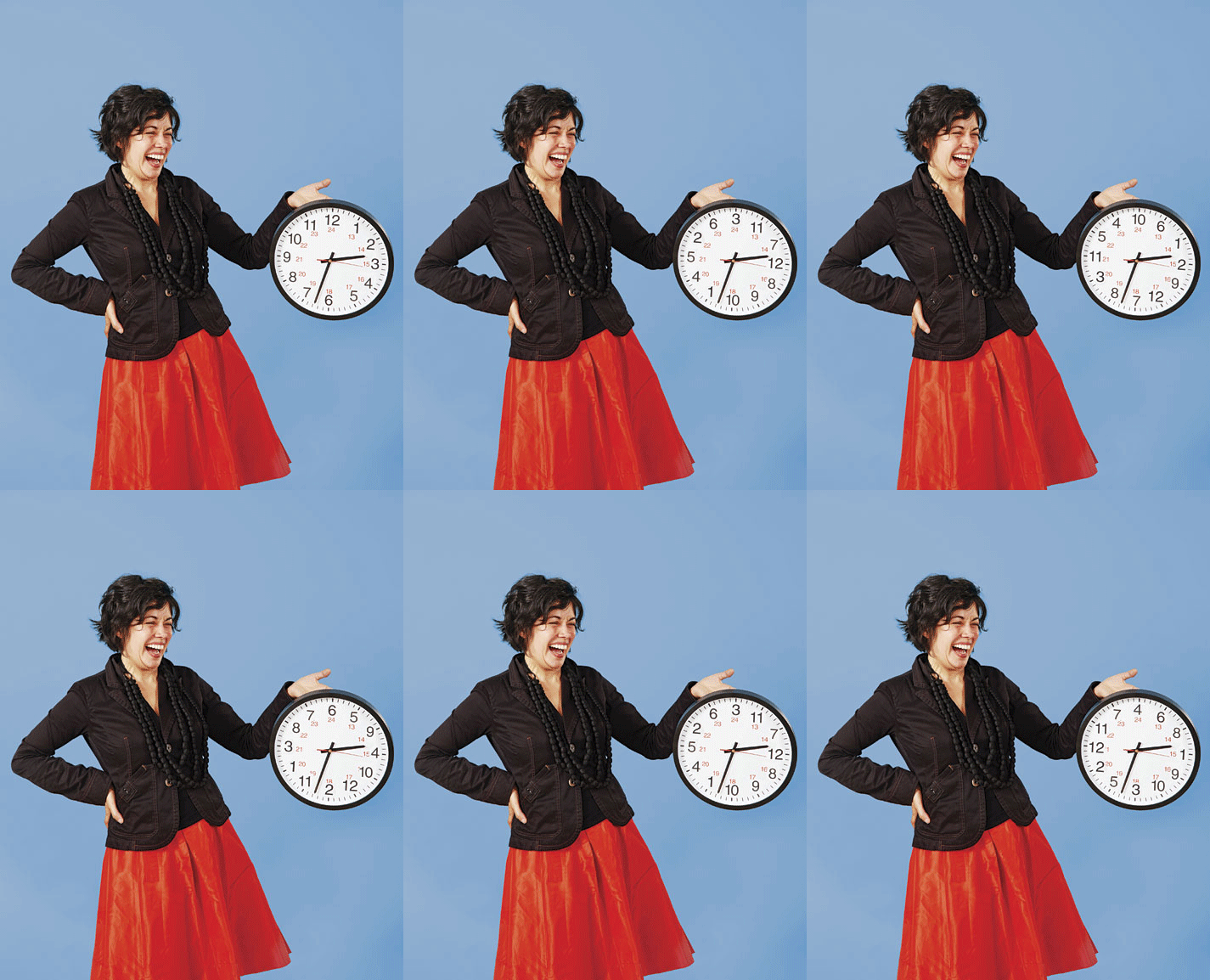
As we discussed on Tim’s show, he and I share an obsession with Time. He’s the Four Hour guy, and I’m the master of time management, what with my odd hours, working in the middle of the night, and defending my hours with standup meetings, few hours online and a lot of free time. In some ways we take opposite approaches: I resist rituals and schedules and regularity. I plunge myself into days-long projects and keep irregular hours. I refuse to conform to the calendar or the clock.
The world we’re living in is controlled by time, by measure—I call it the Technic—and the Technic wants to make us into machines. Why are we working so hard? Because we are competing with machines, which never tire, which never clock out, which never take a weekend off, much less a vacation. We feel our impending obsolescence, that it is only a matter of time before we are replaced by the machines we have created. As Tehching Hsieh’s Time Clock piece so amply demonstrates.
This week I was also reading Breathing by Franco Bifo Berardi, and in it I came across a poem by Hölderlin, In Lovely Blue. He quoted only fragments of the poem, and I was unable to find the whole thing. I ordered three different books of Hölderlin’s poetry to try to find it, and finally did. It turns out it’s not a poem, or wasn’t originally intended as a poem, but was written into one of his novels to demonstrate the graphomania of a madman. This is a sample. But the part of the poem that struck me was this:
Is there measure on earth? There is
None. No created world ever hindered
The course of Thunder.
That we punch clocks is an abomination. That we are time’s slaves is a crime. That we cannot live according to our innate rhythms, but must force ourselves into Time’s procrustean bed is a great and terrible wrong. I rebel against this state of affairs. Let measure go where it belongs: in the building of bridges and the dosages of medicines. But don’t let measure keep me from life and living.
I lie sick in my bed, and this, I suddenly see, if one of the great gifts of being sick: to live outside of the Technic. To live outside of measure and time.
Photo by Jake Stangel for Business Week

